
Publisert 18.12.2025
Actor Antonia Atarah, dance artists Johanna Karlberg and Alen Nsambu, and sound designer and musician Nicolas “Leissi” Rehn spent three weeks at the residency at the Davvi centre for performing arts in Hammerfest in September 2025. We asked the group questions about the residency period and the production.
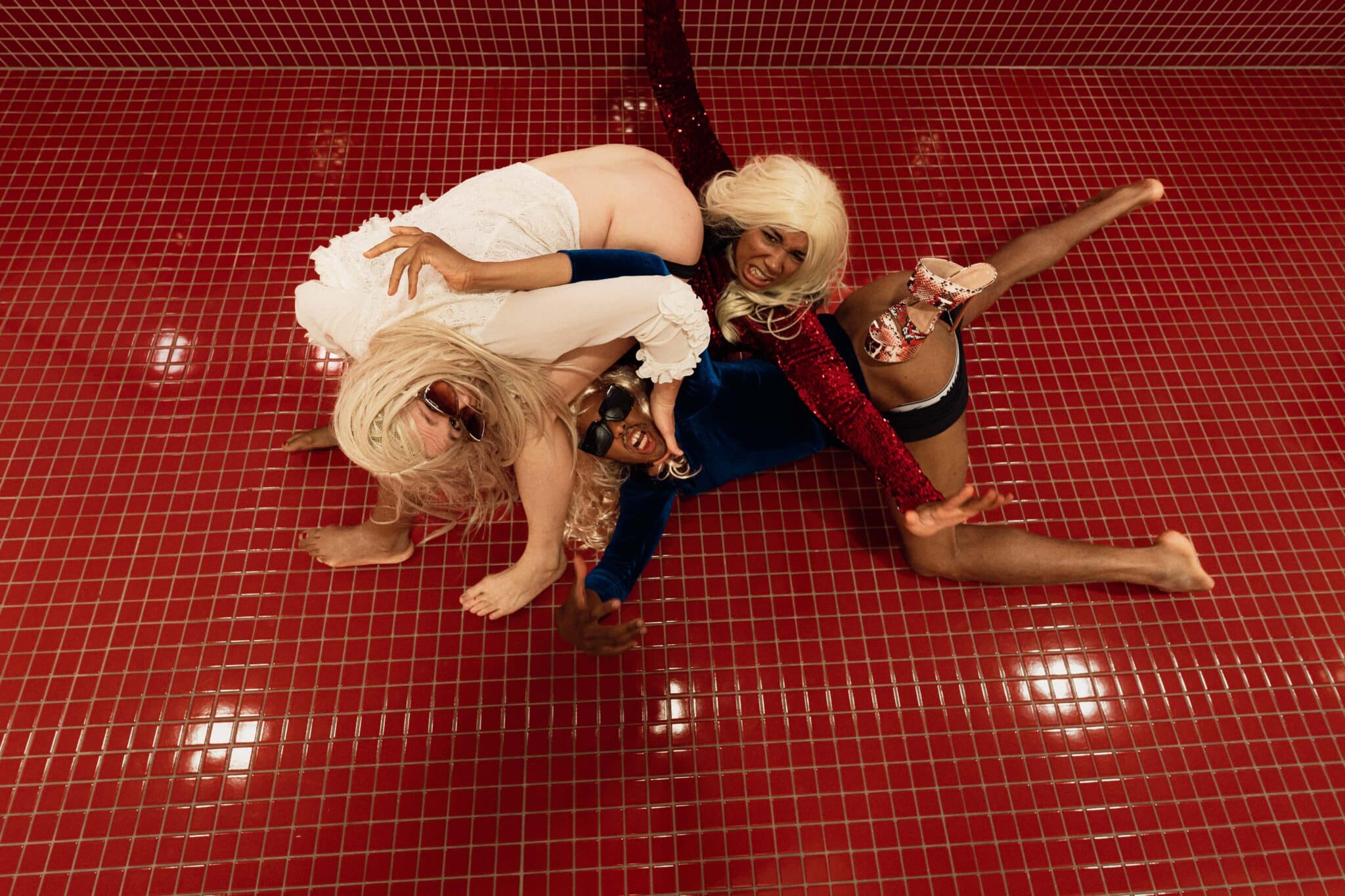
The working group behind Swedish Asshole photographed during the residence in Hammerfest. Photo: Nyvoll Film & Foto
During the residency you worked on the performance art piece Swedish Asshole, which is part of the Viirus GUEST programme and will premiere in spring 2026 in Helsinki. Can you tell us more about the work and what it’s about?
Swedish Asshole is a performance art exploring Finland-Swedish social codes and culture. The Finland-Swedish minority is a remnant of a colonial period in Finland, when the country was under Swedish rule. Rather than being an oppressed minority, Finland-Swedes are the most privileged minority in the world. They are white, wealthy, well-educated and, as a group, enjoy a higher standard of living than the Finnish population at large. The Swedish language in Finland is safeguarded through its status as a national language. The Finland-Swedish person constantly seeks to assimilate into whatever is most advantageous in the moment: Swedish today, Finnish tomorrow. This tendency to trim one’s sails to the wind is characteristic of Finland-Swedes even in a political context; the Swedish People’s Party will do anything to be part of the government.
The performance plays with Finland-Swedish people’s admiration for and aspiration towards everything Swedish, while at the same time, paradoxically, distancing itself from it. It plays with references to reality TV and show culture combined with absurd elements – the red thread is three Swedish Hollywood Wives, suffering from both inferiority complexes and delusions of grandeur, who fight their way through the performance and take on different shapes in a competition to win, to be seen, and to be heard the most. They are repulsive, yet at the same time deeply human and fragile, and hopefully these characters will also spark moments of recognition in the audience.
“The Finland-Swedish person constantly seeks to assimilate into whatever is most advantageous in the moment: Swedish today, Finnish tomorrow.”
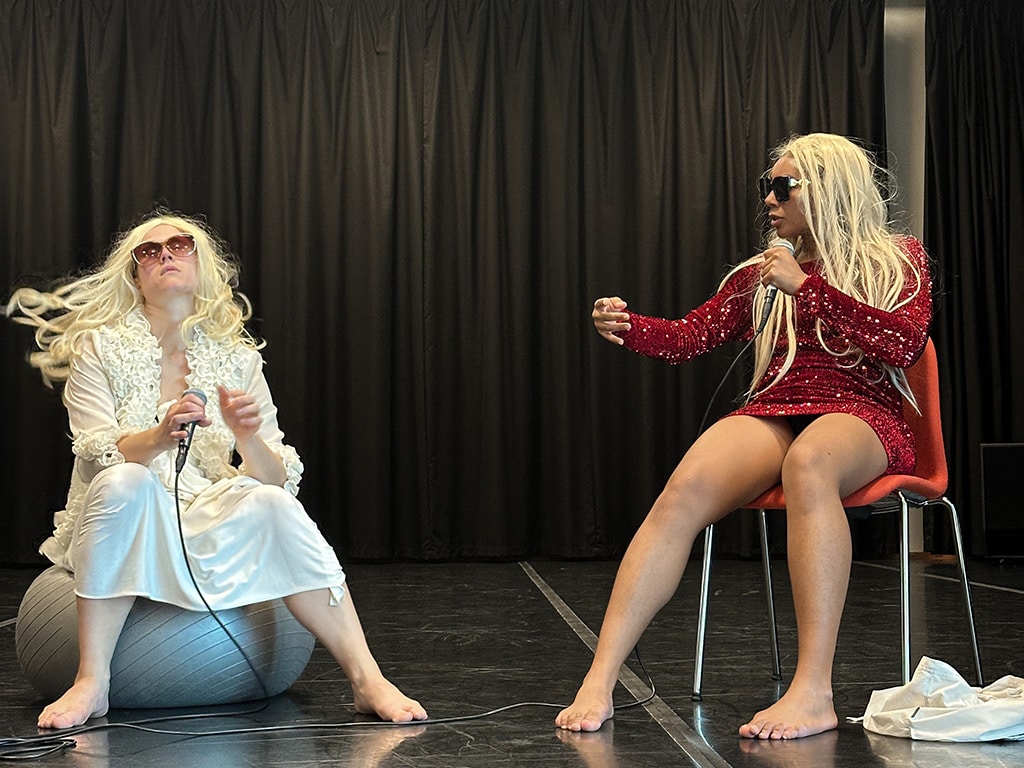
Photo: Magda Nordstrøm
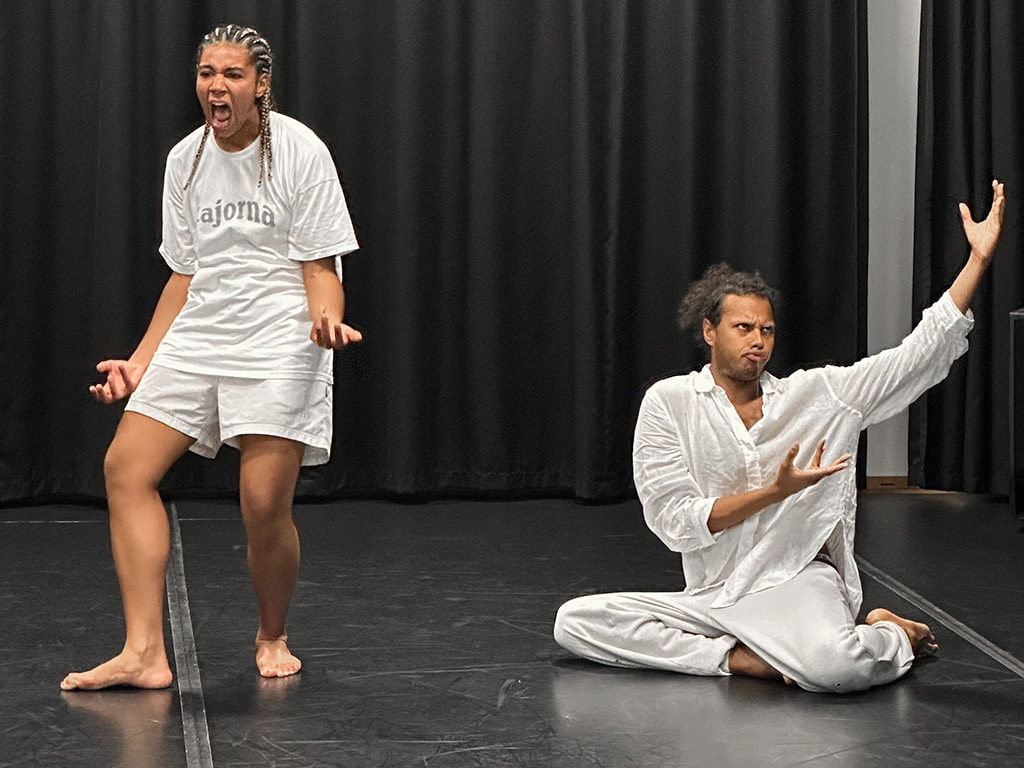
Photo: Magda Nordstrøm
You describe the work as deciphering Finland-Swedish logics and social codes. How do these codes manifest themselves in body and movement on stage, and how do you use the stage space to explore them?
We’ve worked a great deal with audacity – that is, cheekiness and taking up space. We’ve approached different materials with the mentality that, as a performer, one consciously strives to take up as much space as possible, to be seen the most, and to drown out the others. Perhaps a bit of “laddish” energy? A bit of manspreading and rambling monologues – Swedish Asshole is a character who doesn’t question his own opinion, knowledge, or place at the table.
In relation to these methods, we arrive at the core of what we’re working with: how representation and identity affect the art we make and how it is perceived by the outside world. We play a lot with intertextual references and refer to various works that can be placed in the category of “provocative white performing arts” and then re-contextualise them. Swedish Asshole borrows artistic impressions and ideas from right and left without any pangs of conscience; what matters is inspiration and creating interesting art.
How have the place itself and the time spent in Hammerfest influenced your work on Swedish Asshole? Can you describe what the residency has been like and what has been most significant for your work?
The three of us (Johanna, Alen and Antonia) who are on stage were given the opportunity to deepen our shared creative process and the way we work together on stage. After a longer break, we were able to return to our theme and continue developing both old and new ideas. We could then start to see the bigger picture behind how the piece can actually take shape.
We all have different experiences of otherness, which we see as a relevant perspective in relation to the minority we’re portraying. During the residency in Hammerfest, we had the chance to explore our similarities and differences, and to move towards a working method where we function as a trio.
Thanks to our sound designer, we were also able to work in more depth and detail to gain a clearer sense of the work as a whole and the steps that lie ahead. We left Hammerfest not only with the wonderful feeling of having worked incredibly hard in a cultural centre with excellent resources, but also with a clearer picture of the work’s dramaturgy and aesthetics.
“We all have different experiences of otherness, which we see as a relevant perspective in relation to the minority we’re portraying. During the residency in Hammerfest, we had the chance to explore our similarities and differences, and to move towards a working method where we function as a trio.”
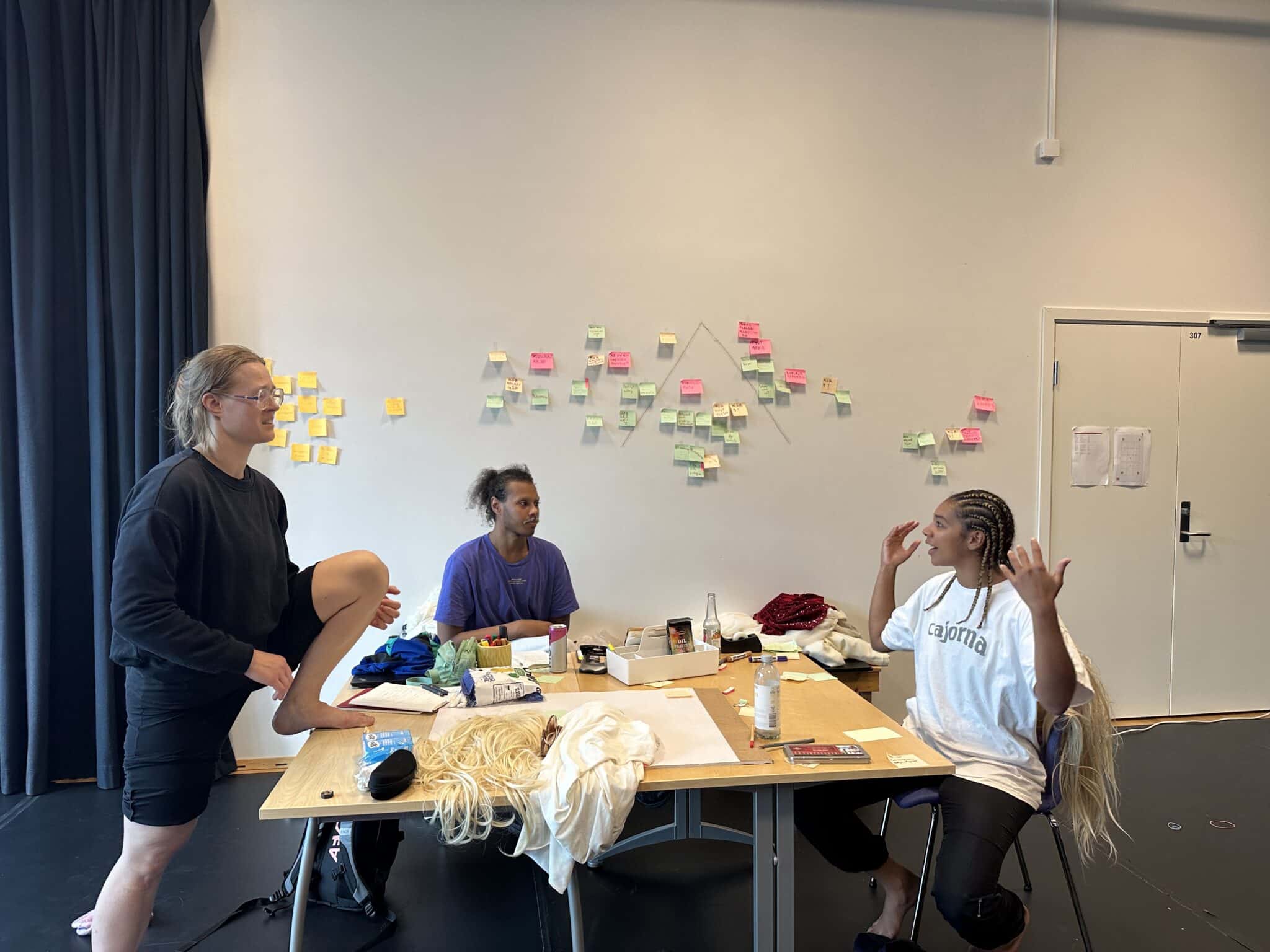
Photo: Magda Nordstrøm
What role does the Nordic context play, and what collaborative possibilities does the Nordic linguistic sphere offer?
The Nordic context plays a central role in our work, as it also addresses the complex and sometimes contradictory “sibling relationship” between Finland and Sweden – a relationship that has profoundly shaped the Finland-Swedish minority. At the heart of this lie language politics and the way the Swedish language has historically influenced identity, belonging, and power relations.
On stage, we play with the sound of the different Nordic languages, and the imitation of their various sonic qualities hopefully creates depth, recognition, and humour for a Nordic audience. Because our countries share so much history, humour, expression, and social codes, large parts of the work are immediately relatable. This recognisability reinforces the work’s themes and allows the audience to see themselves reflected in questions of both friction and belonging that the piece explores. Hopefully, this also opens the door to collaborations and touring opportunities within the Nordic Region.
How do you hope audiences will respond to the work?
Some central questions in the process concern how provocative actions on stage and provocative content are interpreted depending on who is on stage – in other words, how different bodies are assigned different meanings on stage. Norms of whiteness and social status within a Finland-Swedish (and Nordic) context are key starting points. We hope this will spark discussion about whiteness and privilege within Finland-Swedish circles, within the arts field, and in society more broadly.
We have long discussed the need to challenge and create friction through our artistic work. Increasingly, we notice how fear creeps in – fear of saying something inappropriate, fear of touching on topics that are difficult to talk about. Instead, we’re tempted to make ourselves passive and create art that is neutral, impartial, and open to interpretation.
But our society is not a safe space characterised by consensus. Rather, it’s full of structural and hierarchical injustices, and is a place where we’re not all equal. Through art, we have the opportunity to make this visible. We need to dare to shake things up and create art that both addresses and generates friction, and to dare to remain in what is uncomfortable.
A stereotype of Finland-Swedes is that we do everything we can to avoid creating “bad atmosphere”. That’s why we hope the audience might feel a bit of “bad atmosphere” – that something has shifted, chafed, or opened something up. That those sitting in the audience might leave the room feeling a little shaken, a little changed, or in some way affected.
“Some central questions in the process concern how provocative actions on stage and provocative content are interpreted depending on who is on stage – in other words, how different bodies are assigned different meanings on stage. Norms of whiteness and social status within a Finland-Swedish (and Nordic) context are key starting points. We hope this will spark discussion about whiteness and privilege within Finland-Swedish circles, within the arts field, and in society more broadly.”
How do you see the near future panning out for yourselves and for the project?
The entire working group, consisting of a total of eight artists, will continue the artistic process in January 2026, working towards our premiere, which will take place on 4 March. In fact, the most exciting phase of the work still lies ahead of us, when lighting, sound, costume, and props will finally take shape and become a concrete element in the various materials we’ve already created.
–
The residency opportunity was offered in collaboration between Davvi – Centre for Performing Arts, the Swedish Cultural Foundation, and the Finnish-Norwegian Cultural Institute.